
Promoting Research in Pure & Applied Mathematics
Publisher of the Indian Journal of Mathematics (IJM) and Bulletin of the Allahabad Mathematical Society.
Featured Publications & Journals
Peer-reviewed international publications
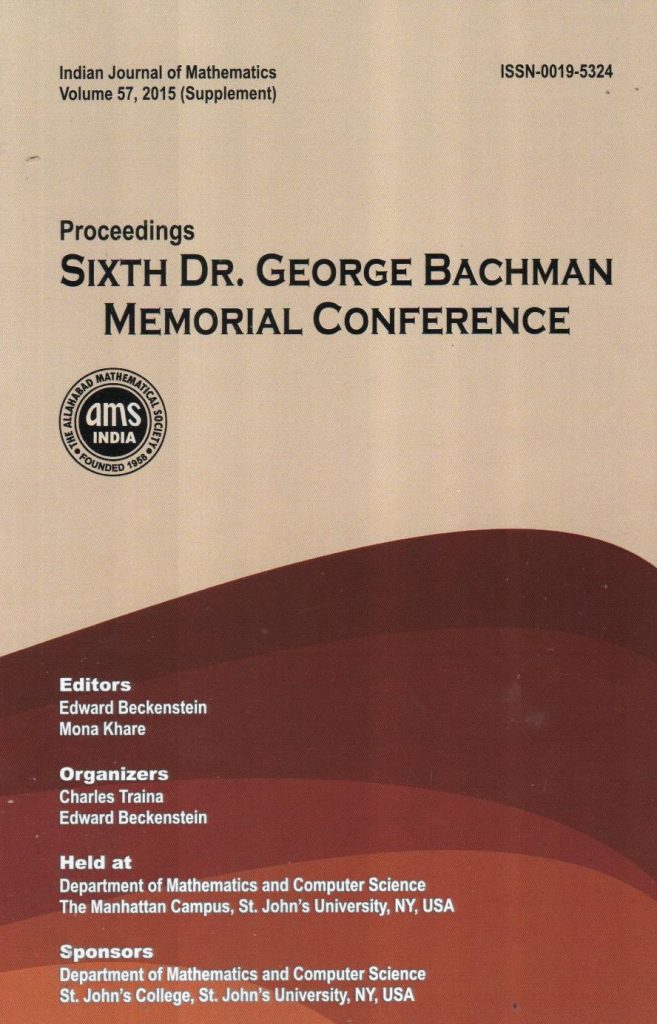
Dr. George Bachman Memorial Conference
ISSN-0019-5324
ISSN-0019-5324
Lecture Note Series
Recent Publications
Latest peer-reviewed articles from our journals
Mathematical Transform Technique Through the Sound Waves
Author: Gajanan Dhanorkar, Shrikant Jakkewad, Rugved Thakur
This paper contains a encoding of input data into audio signal based transform technique to get original output. In this process data transformed into a distinct frequency using a linear mapping function. These frequencies are synthesized as discrete-time sinusoidal signals and concatenated to form an encrypted audio waveform. In decoding frequency-domain analysis through the Discrete Fourier Transform (DFT) and its computationally efficient variant, the Fast Fourier Transform (FFT). By detecting the dominant frequency present in each time segment, the original prime number and corresponding alphabetic character are accurately recovered. The proposed system integrates number theory, trigonometry, sampling theory, and harmonic analysis, providing an interdisciplinary framework suitable for cryptography education, digital signal processing demonstrations, and mathematical visualization of encryption concepts.
Reducing Customer Abandonment Through the Characteristic Function of Two Queueing Games with Exponential Reneging
Author: D. Dutta, M. K. Patel
Customer abandonment, also known as reneging, is a major problem for queueing systems. A high amount of reneging in a queueing system leads to reduced goodwill for the system. Queueing systems therefore aim to reduce reneging. Reneging is therefore modeled as a cost on the queueing system. In this paper, we propose a cooperative game theoretic approach to solve the problem of reneging in queueing systems with Poisson arrival, exponential service times and exponential reneging. We define two aggregation principles. These two aggregation principles give us two types of cooperative games. We consider the characteristic function as the average reneging rate in both games. We establish an inequality between the values of the characteristic functions of the two games. Subadditivity of the games is explored using random sampling. Furthermore, a differential evolution algorithm is used to find the non-emptiness of the core in both games. Finally, we use numerical illustrations to demonstrate the cost reduction that can be achieved using the two different aggregation principles. The nucleolus is used for distributing the cost of the grand coalition. The cost of reneging for each player in game one is compared with the cost for that player in game two.
A Preliminary Note on a mixed finite difference approach for a singularly perturbed Gait model
Author: Shubhangini Gupta, Sourav Banerjee, Tamal Pramanick
In this research, we introduce a simulation based numerical technique for addressing a class of linear second-order ordinary differential equations derived from a simplified biologically inspired model of human gait. Although the governing equation is posed as a time-dependent ODE, its inner rescaled formulation exhibits singular perturbation structure characteristic of boundary layer type behavior. The model incorporates significant physical aspects like gravity, damping, and leg stiffness, while also illustrating the vertical motion of the body's center of mass during ambulation or running. Standard numerical schemes may struggle to accurately resolve steep solution gradients arising for small perturbation parameters. To address this, we employ an asymptotic inner-outer decomposition combined with a time rescaling transformation to capture boundary layer behavior effectively. The Thomas approach is used to quickly solve the resulting tridiagonal problems within the mixed finite difference framework. The numerical experiments are also presented in order to validate the theoretical findings.